
Practical
How to Stop a Dumpster Wrecking Your Driveway
A loaded roll-off puts several tons on four small steel contact points. Around here the driveway is only half the problem — the other half is the clay underneath it.
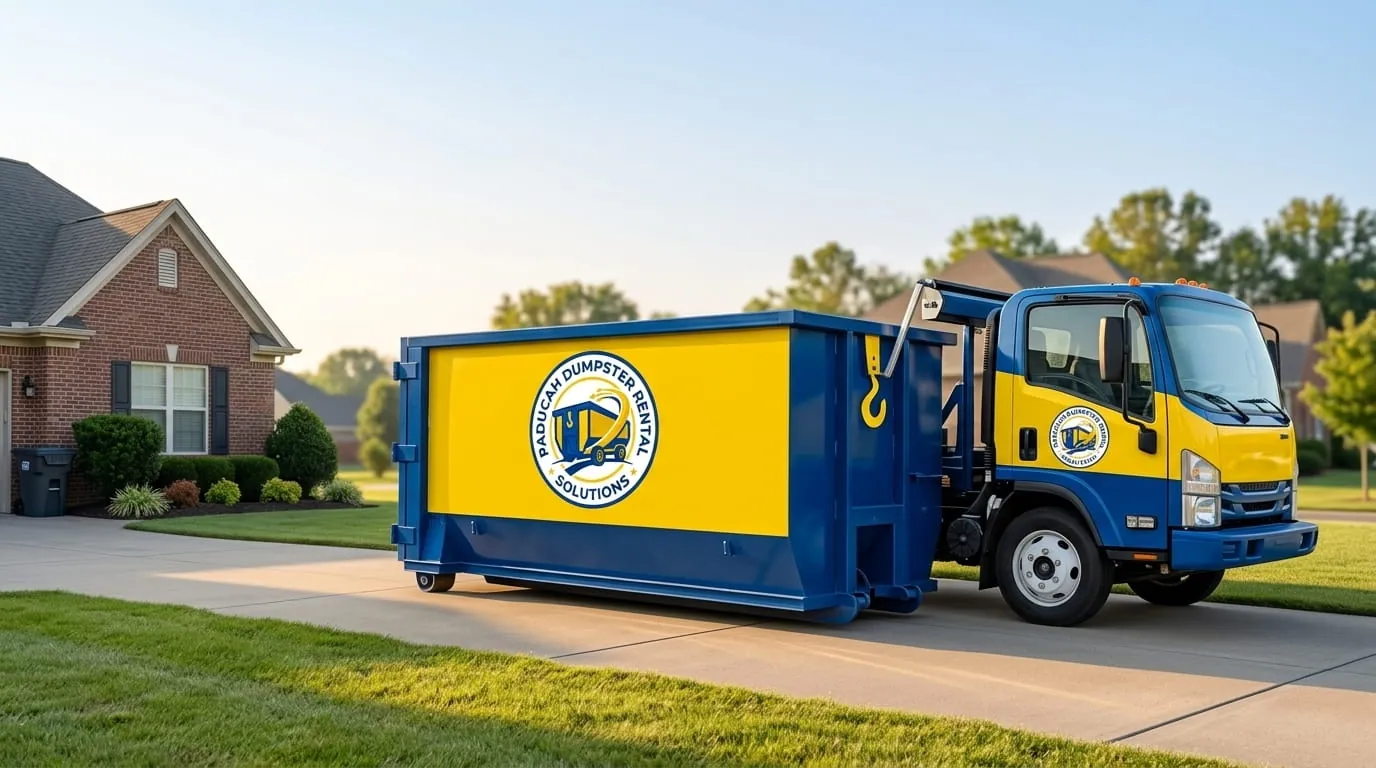
Why this matters here
Two things make western Kentucky harder on driveways than people expect.
The first is freeze-thaw. We do not get northern-plains winters, but we get something arguably worse for concrete: repeated cycling around freezing point. Water gets into a crack, freezes, expands, levers the crack wider, then thaws and lets more water in. A winter here can deliver a great many of those cycles, and the result is that a driveway which looked sound in October can have real weakness by March.
The second is clay. The subsoil across most of this region holds water and drains slowly. That means the ground under a driveway — and under any unpaved placement — behaves very differently in a wet week than a dry one, regardless of how solid the surface looks.
How the damage actually happens
People picture the container's weight spread across its footprint. It is not. A roll-off sits on two steel rails and concentrates load at a small number of contact points — typically the rear wheels and the front of the rails.
A 20 yard loaded to four tons, plus the container's own weight, puts something in the order of several thousand pounds onto each of those points. Three distinct mechanisms follow:
- Static load. The container sitting there over days, gradually pressing in.
- Dynamic load during delivery. The moment the container rolls off and the rear wheels touch down is the highest instantaneous load of the whole rental.
- Dragging. Winching the container back on drags the rails across the surface. On decorative concrete this is what causes scoring.
What protection boards do
Plywood under the rails spreads a point load across a much larger area. It is unglamorous and extremely effective — the difference between several thousand pounds on four small contacts and the same weight distributed across several square feet.
Our drivers carry plywood on every truck as standard equipment. Boards go down before the container touches the surface, not afterwards, and they go down again on collection because the drag-on is as damaging as the drop-off. On stamped and decorative concrete we double up.
Clay subsoil and wet weather
This is the part people underestimate, because the surface gives you no warning.
After a sustained wet spell, clay subsoil holds water and softens. A concrete drive over saturated clay can crack because the support beneath it has gone. A gravel drive will rut deeply. A lawn placement will leave marks you are repairing for months, and in bad cases the truck itself gets stuck — which turns a routine delivery into a recovery operation and does far more damage than the container ever would.
What we will do is be straight with you. If we think the timing is a problem we will suggest the firmest available standing — usually right at the road — or suggest waiting a few days. That occasionally disappoints people. It is still the right call.
Surface by surface
Concrete driveway
Generally fine with boards down. Watch for existing cracks and spalled edges from previous winters — a slab that is already cracked will preferentially fail along that line. Point them out and we will place away from them.
Asphalt
Very common here and vulnerable in summer. Asphalt softens in heat and a container will press straight into it; a week on hot asphalt can leave permanent depressions. Boards are essential, and in July we may suggest a different spot altogether.
Gravel and chip-and-seal
Extremely common on rural property and generally the most forgiving surface. Some displacement, easily raked back. The caveat is what is underneath — a thin gravel layer over clay is really a clay driveway with a dusting on top, and it behaves like clay when wet.
Stamped and decorative concrete
Doubled boards as standard, and we lift rather than drag where possible.
Grass and bare ground
Workable when firm and dry, and often the best option on acreage. Not after heavy rain.
What is underneath
Septic systems. Very common across rural McCracken, Ballard, Graves and Livingston Counties. Never place a container over a tank or lateral field — the weight can crush a tank lid or compact the field, and the repair runs into thousands. Know where yours is.
Water wells and cisterns. Also common on rural property. Keep clear.
Irrigation and utility laterals. Shallow-buried and easily crushed, particularly in a lawn placement.
A word about mature trees
The older streets in Lone Oak, Hendron, Reidland and the Paducah historic district are known for their shade trees, and they are genuinely one of the nicest things about those neighbourhoods. They are also our most common access constraint.
Rolling a container off the truck means raising the bed, which needs roughly twenty-two feet of clear height. A mature oak arching over the driveway does not negotiate. Mention the tree when you book and we will plan the placement — usually further forward where the canopy opens — rather than arriving and finding we cannot tip.
Worth adding: the root plate of a large tree extends well beyond the canopy, and parking several tons over it for a fortnight compacts the soil. If you are fond of the tree, we will site away from it.
If something does go wrong
It is uncommon, but it happens. Tell us straight away rather than after the container is gone. Photograph it. We are licensed and insured, and where damage results from our placement we deal with it rather than arguing about it. Having before-and-after photographs makes that conversation short and civil, which is why we suggest taking the before ones.
What we cannot take responsibility for is damage from a hazard nobody told us about — a septic tank we did not know was there, or a driveway already failing that we were not shown. Which is exactly why the two minutes of conversation at booking genuinely matters.
The short version
- Boards go under the rails on every delivery. If a hauler does not do this as standard, use a different hauler.
- Tell us about existing cracks, spalling and weak edges.
- Tell us if the ground has been wet, and be open to placing nearer the road.
- Mention low branches — we need about twenty-two feet of clear height.
- Photograph existing damage before delivery.
- Know where your septic, well and irrigation lines run, and say so.
Need a container in Paducah?
Call and describe the job. Three minutes on the phone gets you a size recommendation, a flat rate and a delivery window — and we will tell you if a smaller, cheaper container is the right answer.
Call (270) 477-4085